
Blog
Drawer Rails: Ball Bearing, Soft Close & Push to Open Guide

Drawer Rails: Ball Bearing, Soft Close & Push to Open Guide
Drawer rails decide whether a cabinet feels premium or cheap. Nothing else in furniture hardware communicates quality so quickly.
A buyer opens a drawer once and forms a permanent judgement. It glides, or it grinds. It closes softly, or it slams. Therefore, specifying the right drawer rails is one of the highest-leverage decisions in cabinet making.
However, the hardware market is crowded and confusing. Suppliers mix terminology freely. “Ball bearing,” “soft close,” and “push to open” get used as if they were interchangeable. They are not.
This guide breaks down all three mechanisms in plain terms. Furthermore, it covers load ratings, cycle counts, sizing, and the honest limits of each type. Here’s exactly how to choose drawer rails that still work perfectly after 100,000 cycles.
Why Cheap Drawer Rails Fail Long Before Their Rated Cycle Count
Most hardware failures trace back to one decision: buying drawer rails on price alone.
Cheap slides use thin gauge steel and undersized ball cages. Consequently, the race deforms under load within a few thousand cycles. Additionally, budget dampers leak hydraulic fluid and lose their soft close action entirely.
The numbers are unforgiving. A busy family kitchen opens a given drawer 20 to 30 times daily. That’s roughly 9,000 cycles per year. Therefore, a slide rated for 30,000 cycles fails in under four years.
The cost extends far beyond the hardware:
- Callback labor on installed cabinetry: $80-$150 per visit
- Reputation damage for cabinet makers and fitters
- Customer complaints that no discount can repair
- Full slide replacement at your own expense
Moreover, cheap drawer rails often fail unevenly. One side seizes while the other still travels. This twists the drawer box and cracks the joints. Therefore, a $3 saving per pair can destroy a $400 cabinet.
Soft Close Drawer Rails: The Hydraulic Damper Explained
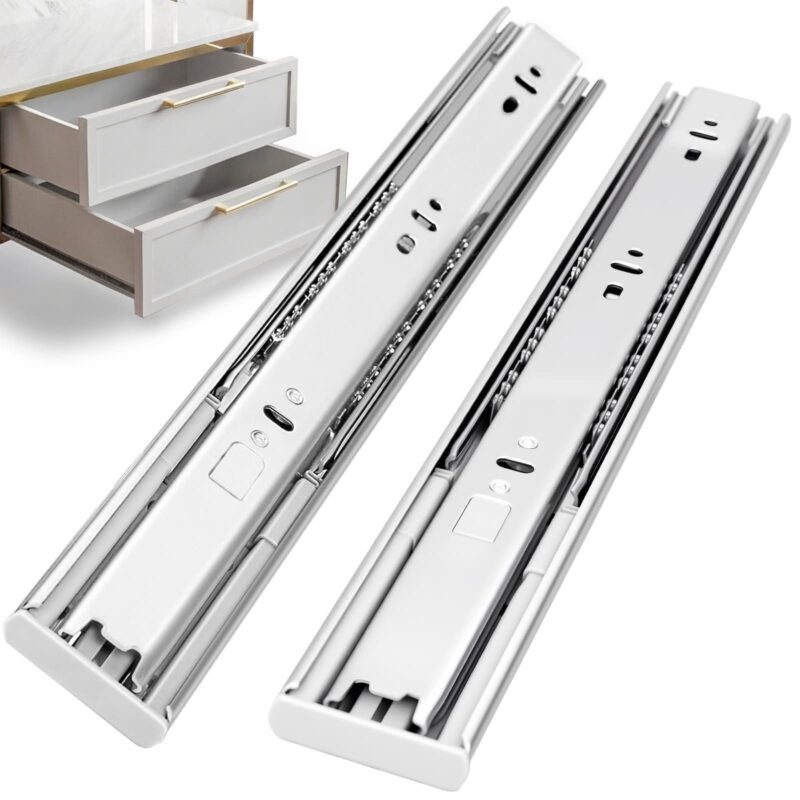
Soft close drawer rails add a hydraulic or pneumatic damper to a ball bearing chassis. The damper engages in the final 50-70 mm of travel.
Instead of slamming, the drawer decelerates and settles shut. Consequently, you get three practical benefits:
- Noise reduction in open-plan kitchens and offices
- Reduced wear on drawer fronts and cabinet frames
- Perceived quality that justifies a higher sale price
However, damper quality varies enormously. Premium units hold their action past 50,000 cycles. Inexpensive dampers often fail within 5,000 cycles. Therefore, always ask for cycle test
Push to Open Drawer Rails: Handle-Free Operation Done Right
ush to open drawer rails eliminate handles entirely. A light press releases a spring-loaded latch, and the drawer glides out.
This mechanism dominates modern handleless kitchen design. Additionally, it suits wall units, bathroom vanities, and any cabinet where protruding hardware is unwelcome.
Two mechanisms dominate the market:
- Mechanical catch: reliable, no magnets, adjustable tension
- Magnetic push latch: simpler, but weaker holding force
Furthermore, push to open drawer rails pair naturally with soft close. The damper controls closing, and the latch controls opening. Combined, they deliver full handle-free operation.
Side Mount vs. Undermount: Choosing the Right Drawer Rails
Mounting position affects both appearance and performance.
- Side mount: visible when the drawer opens, easier to install, lower cost
- Undermount: hidden beneath the drawer box, cleaner look, better load distribution
Undermount drawer rails cost roughly 30-50% more. However, they deliver superior aesthetics and smoother travel. Therefore, they dominate high-end residential work.
What About Load Ratings and Cabinet Fit for Drawer Rails?
ren’t Imported Drawer Rails Just as Good?
Some are. Many are not. The difference lies in steel grade and quality control.
Reputable factories test drawer rails to BIFMA X5.1 or EN 15338 standards. These tests measure deflection under load and cycle endurance. Consequently, a certified product carries documented proof.
Uncertified hardware carries a promise. Therefore, always request test reports before committing